
Water Quality Planning for Medical Aesthetic and Dental Clinics: Reducing Infection and Equipment Risks
Water quality in a dental or medical aesthetic clinic is not simply a matter of choosing the “purest” water available. Different applications have different requirements, and the water suitable for handwashing, a dental treatment unit, an autoclave, or specialized clinical equipment may not be the same.
For this reason, effective water planning begins with a more practical question: What water quality does each application actually require?
Municipal tap water is treated for general public use, but clinical equipment may introduce additional considerations such as microbial control, mineral scaling, particulates, equipment compatibility, and manufacturer-specified water requirements.
Rather than assuming that every outlet in a clinic needs the same level of purification, a better approach is to match water quality and treatment to how the water will actually be used.
Why Water Quality Matters in Clinical Environments
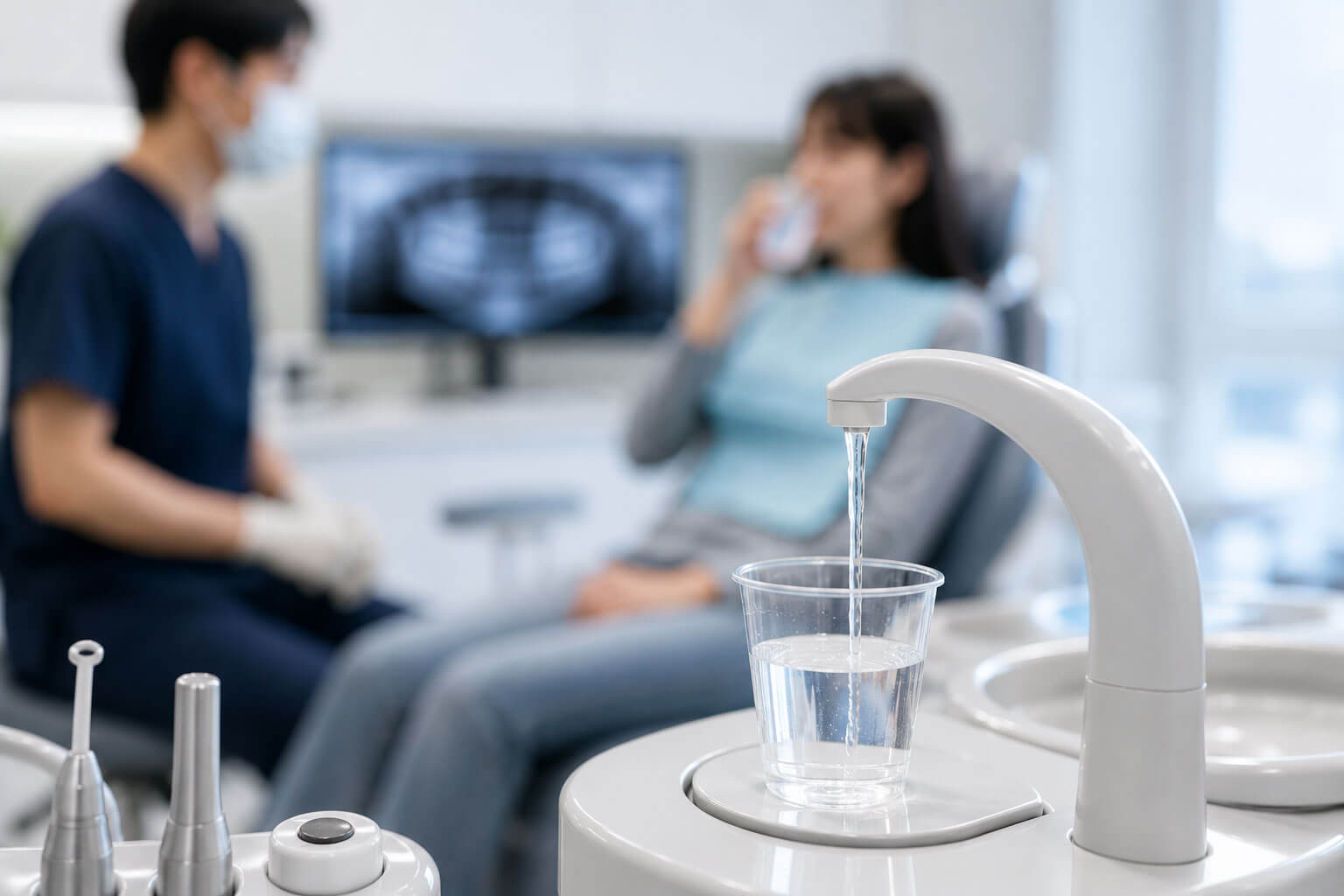
Water is used throughout dental and medical aesthetic facilities, but not always for the same purpose.
Common applications may include:
- Dental treatment units
- Instrument cleaning
- Steam sterilizers and autoclaves
- Medical aesthetic treatment equipment
- Laboratory equipment
- Handwashing stations
- Procedure preparation areas
- General cleaning and sanitation
The key point is that these applications should not automatically be grouped under a single water-quality specification.
For example, the U.S. Centers for Disease Control and Prevention (CDC) recommends that water used for routine nonsurgical dental treatment meet applicable drinking-water microbiological standards. For oral surgical procedures, however, deliver sterile saline or sterile water through an appropriate sterile delivery system.
Requirements for autoclaves, laboratory instruments, and medical aesthetic equipment may differ again. In these cases, the equipment manufacturer's instructions and applicable local clinical or regulatory requirements should be part of the water-system planning process.
This is why the goal is not simply “purer water everywhere.” The goal is the right water quality for the right application.
Clean Water and Purified Water Are Not the Same Planning Question
Municipal water is treated for public use and is generally appropriate for drinking and everyday facility operations when it complies with local standards. But the quality of water entering a building does not by itself determine whether that water is appropriate for every piece of clinical equipment.
Premise plumbing, storage conditions, periods of stagnation, water hardness, dissolved minerals, particulates, and downstream equipment can all affect how water behaves inside a facility.
Additional treatment may therefore be considered where an application requires tighter control of specific water characteristics.
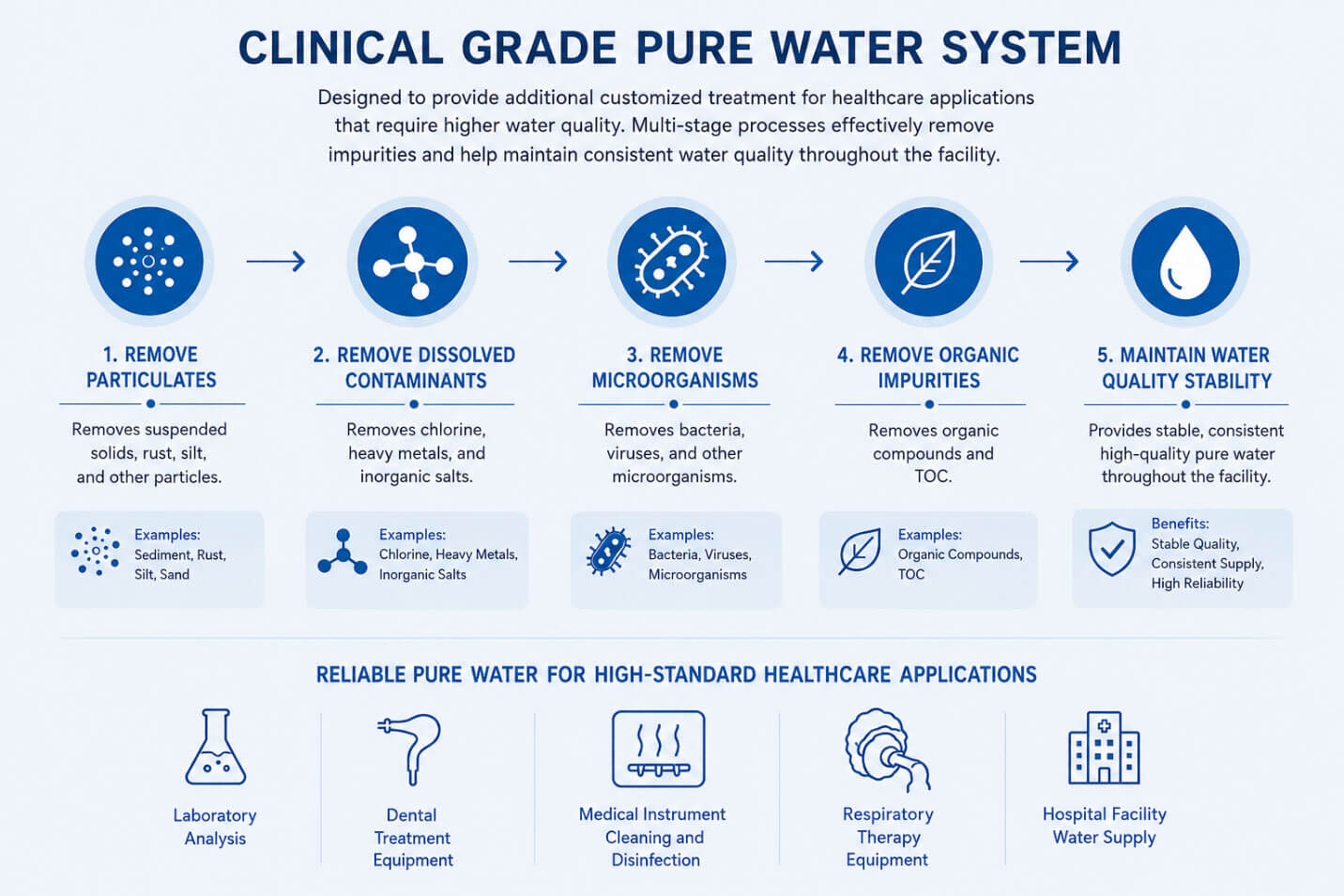
Depending on the application and source-water conditions, a treatment system may address:
- Suspended particles and sediment
- Dissolved minerals and salts
- Scale-forming hardness
- Microbial load
- Organic contaminants
- Consistency of water quality supplied to sensitive equipment
The appropriate treatment approach should be defined by the source-water conditions, the equipment being supplied, and the required water quality at each point of use.
Dental Unit Waterlines Show Why Water Management Goes Beyond the Incoming Water Supply
Dental treatment units are a useful example of why clinical water quality cannot be managed only at the building's water inlet.
Dental unit waterlines typically use narrow tubing, low flow rates, and may experience periods of stagnation. These conditions can allow microorganisms to attach to internal surfaces and form biofilms. Once established, biofilm can release microorganisms back into the water flowing through the unit.
For this reason, professional dental infection-control guidance emphasizes regular treatment, maintenance, and monitoring of dental unit waterlines, together with following the equipment manufacturer's instructions.
This also means that purified source water alone does not automatically solve a waterline biofilm problem. Source-water treatment, waterline design, flushing, disinfection protocols, equipment maintenance, and verification all need to work together.
Medical Aesthetic Equipment Has Different Water Requirements
Medical aesthetic equipment introduces a different set of water-quality considerations.
Some laser and energy-based systems use internal water-cooling circuits and may specify distilled, deionized, or otherwise controlled water to help maintain stable cooling and protect internal components.
In these systems, the main concern may not be drinking-water quality at all. Water chemistry, mineral content, deposits, circulation, and equipment compatibility can become more important.
Using water outside the manufacturer's specification may contribute to deposits, flow restrictions, or increased maintenance requirements over time.
However, this does not mean that every laser, aesthetic device, or treatment system requires purified water.
The correct specification should always be confirmed against the equipment manufacturer's instructions and the way water is actually used within the device.
This distinction is important because the water used inside an equipment cooling circuit is also not necessarily the same as water or sterile fluids used directly during a clinical procedure.
Should a Clinic Use Separate Water Supplies for Different Applications?
In some facilities, separating general-use water from water intended for equipment with more specific quality requirements can be a practical design option.
Instead of treating every outlet in the building to the same level, the facility can first identify which applications genuinely require additional treatment and then design the distribution system accordingly.
General Water Supply
Depending on local water quality and regulations, standard municipal or appropriately treated building water may be suitable for uses such as:
- Restrooms
- Handwashing sinks
- Floor cleaning
- General housekeeping
- Staff kitchens
Application-Specific Treated Water
Additional treatment may be considered for applications such as:
- Certain dental treatment systems
- Steam sterilizers, according to manufacturer requirements
- Instrument cleaning equipment
- Medical aesthetic equipment with defined water specifications
- Laboratory equipment
- Other processes requiring controlled water chemistry or microbial quality
This type of zoning or dedicated-water approach can help avoid unnecessary treatment of the entire building while allowing tighter water-quality control where it matters.
However, a dedicated or dual-supply system should not be treated as a universal requirement for every clinic.
The correct configuration depends on source-water quality, building layout, equipment specifications, peak demand, local requirements, and the facility's ability to maintain the system over time.
Which Water Treatment Technologies May Be Used?
No single water-treatment technology solves every problem.
A well-designed system may combine several treatment stages, with each technology selected to address a specific water-quality requirement.
Reverse Osmosis for Dissolved Minerals and Scale Control
Reverse osmosis uses a semi-permeable membrane to reduce dissolved salts, minerals, and other dissolved substances in water.
In dental and medical aesthetic facilities, RO may be considered where reducing dissolved minerals or controlling scale is important for downstream equipment.
This can be particularly relevant when the local feed water has relatively high mineral content or when an equipment manufacturer specifies purified or low-mineral feed water.
For steam sterilizers, for example, equipment specifications may define acceptable limits for parameters such as conductivity, hardness, or dissolved solids. These values should be checked against the individual manufacturer's instructions instead of applying one universal number to every sterilizer.
Puricom's commercial and industrial RO systems can support projects where higher-capacity or application-specific water treatment is required.
The important point is that RO should not be selected simply because a facility is medical or dental. It should be selected when the required water quality and source-water conditions justify it.
UV Disinfection for Microbial Control
UV treatment can be incorporated as a disinfection step when microbial control is part of the water-treatment requirement.
However, its role should be clearly understood.
UV does not remove dissolved minerals or sediment, and it does not physically remove established biofilm from downstream piping or equipment.
Its performance also depends on factors such as incoming water quality, flow rate, system design, equipment condition, and regular maintenance.
Puricom's UV sterilization systems can be incorporated into broader water-treatment configurations where an additional microbial-control stage is appropriate.
RO and UV therefore serve different purposes. One should not be treated as a substitute for the other.
Biofilm Control Requires More Than One Treatment Device
Biofilm management is primarily a system-management issue rather than something that can be solved by adding one filter or treatment stage.
Depending on the application, effective management may involve:
- Appropriate waterline and piping design
- Avoiding unnecessary stagnation
- Routine flushing where specified
- Compatible disinfection procedures
- Scheduled system sanitization
- Water-quality monitoring
- Following equipment and treatment-product instructions
This is especially important in dental waterlines, where narrow tubing and intermittent water use can create conditions that encourage biofilm development.
Clinical Water Planning Should Start with the Application, Not the Equipment Catalogue
A dependable water-treatment system should be designed only after the facility understands what the water will be used for.
Before selecting an RO system, UV unit, filtration stage, or distribution layout, clinic operators and project partners should consider four questions.
1. What Water Quality Does Each Application Require?
Dental units, sterilizers, aesthetic equipment, laboratory instruments, and other water-dependent systems should be evaluated separately.
Where an equipment manufacturer specifies feed-water requirements, those specifications should be included in the system design.
The fact that two devices are installed in the same clinic does not necessarily mean they should receive water of the same quality.
2. What Is the Incoming Water Quality?
Water-treatment design should reflect actual source-water conditions.
Hardness, dissolved solids, particulates, chlorine, microbiological conditions, and other parameters can vary significantly between locations.
A treatment configuration that works well in one market or building may therefore not be appropriate for another without first evaluating the local water supply.
3. What Is the Facility's Peak Water Demand?
Water quality is only one side of system design.
A treatment system that produces the required water quality but cannot deliver sufficient flow or capacity during peak operating periods can still create operational problems.
Flow rate, storage requirements, simultaneous equipment use, operating hours, and possible future expansion should therefore be considered during planning.
4. How Will Water Quality Be Maintained and Verified?
Water-treatment performance depends on what happens after installation.
Filters, membranes, UV components, storage tanks, piping, and downstream equipment all require appropriate inspection and maintenance.
A complete plan should therefore consider filter and component replacement, system sanitization, monitoring, maintenance procedures, and water-quality verification rather than focusing only on the initial equipment purchase.
A Better Way to Think About “Clinical-Grade” Water
The term “clinical-grade water” can be useful as a general description, but it should not be interpreted as one universal water specification that applies to every dental or medical application.
A more useful planning framework is:
Application → Required Water Quality → Water Risk → Treatment Method → Distribution → Maintenance and Verification
This approach helps avoid both under-treatment and unnecessary over-treatment.
More importantly, it keeps the system focused on the actual application instead of assuming that one purifier, membrane, or disinfection technology can satisfy every requirement.
How Puricom Supports Application-Specific Water Treatment Projects
Puricom has decades of experience in water-treatment product development and manufacturing, with solutions covering residential, commercial, industrial, laboratory, and customized applications.
Its product capabilities include RO systems, commercial and industrial water-treatment equipment, UV technologies, filtration components, and related system solutions.
For equipment manufacturers, system integrators, distributors, and project partners serving dental and medical aesthetic facilities, the starting point should not simply be choosing a product from a catalogue.
It should be defining the required water quality, source-water conditions, treatment capacity, equipment interface, installation environment, and long-term maintenance requirements.
For projects requiring customized product or system development, Puricom also provides an OEM/ODM cooperation process that supports requirement confirmation, product development, testing, manufacturing, quality inspection, and ongoing cooperation.
By matching treatment technologies and system design to the intended application, project partners can establish a more manageable water-quality strategy that supports equipment reliability, operational consistency, and long-term risk management.
Frequently Asked Questions
Q: Is municipal tap water suitable for dental and medical aesthetic clinics?
A: Municipal water may be suitable for many general facility uses, but it should not automatically be assumed to meet the requirements of every clinical device or procedure. The appropriate water quality should be determined according to the intended application, equipment manufacturer's instructions, local requirements, and actual source-water conditions.
Q: Do all clinical applications require RO water?
A: No. RO is useful when dissolved minerals, salts, or other dissolved substances need to be reduced, but not every clinical application requires the same level of purification. RO should be selected according to the required water quality and source-water conditions rather than installed simply because the facility is medical or dental.
Q: Does every medical aesthetic device require purified water?
A: No. Some laser or energy-based devices may specify a particular water quality for their internal cooling systems, while other equipment may use different cooling methods or have different requirements. Always confirm the water specification in the equipment manufacturer's instructions before planning the treatment system.
Q: Can UV treatment prevent biofilm in dental waterlines?
A: UV can help reduce microorganisms passing through a properly designed treatment point, but it does not by itself remove established biofilm from downstream tubing. Dental waterline management may require a combination of appropriate water treatment, disinfection, flushing, monitoring, and equipment-specific maintenance procedures.
Q: Should an entire clinic be supplied with purified water?
A: Not necessarily. A more efficient approach may be to identify which applications require additional treatment and provide controlled water quality only where it is needed. The appropriate system layout depends on the clinic's equipment, incoming water quality, building configuration, water demand, and maintenance requirements.